


B2B marketing has a reflex. When it’s time to launch a product, the playbook kicks in: features first, functionality second, compliance third. Then hand it to comms and ask them to “get some coverage.”
It’s tidy. It’s familiar. And it caps your ceiling before you’ve even started.
Two companies in the same category are showing what happens at either end of that spectrum. One is the market leader, going broad, pumping marketing spend while its product and UX quietly stagnate. The other is a former incumbent that lost its crown and is doing something far more interesting to earn it back. The results are worth paying attention to.
Broad vs. niche: the Xero and MYOB divergence
For anyone who’s been around the Australian and New Zealand accounting software market, the history here matters. MYOB was the market leader. For years, they owned the category. Then Xero came along, went cloud-first, executed brilliantly, and took the crown. It’s one of the best challenger brand stories in the region.
Then they won. And something shifted. Xero has spent recent years positioning itself as the default cloud accounting platform. Broad market, broad messaging, broad brand. The marketing machine keeps running. The billboards keep going up. But when you talk to the people actually using the product every day, there’s a growing gap between the brand promise and the product experience. The roadmap feels like it’s treading water. Features that users actually care about stay parked while the company chases scale and promotion.
That’s where vanity creeps in. Vanity metrics, vanity features, vanity positioning. The brand looks great from the outside, but the substance underneath isn’t keeping pace.
Meanwhile, MYOB has been quietly doing the opposite. Instead of trying to win back the broad SME market with a louder version of the same playbook, they went niche. With Solo, they zeroed in on one audience: Australia’s 1.6 million sole operators. Freelancers, tradies, side hustlers, celebrants. People running real businesses who don’t always feel like they’re running real businesses. And instead of leading with what the product does, they led with what that audience actually feels.
It’s a challenger move from a former incumbent. And it might be exactly the right one.
Culture first, category second
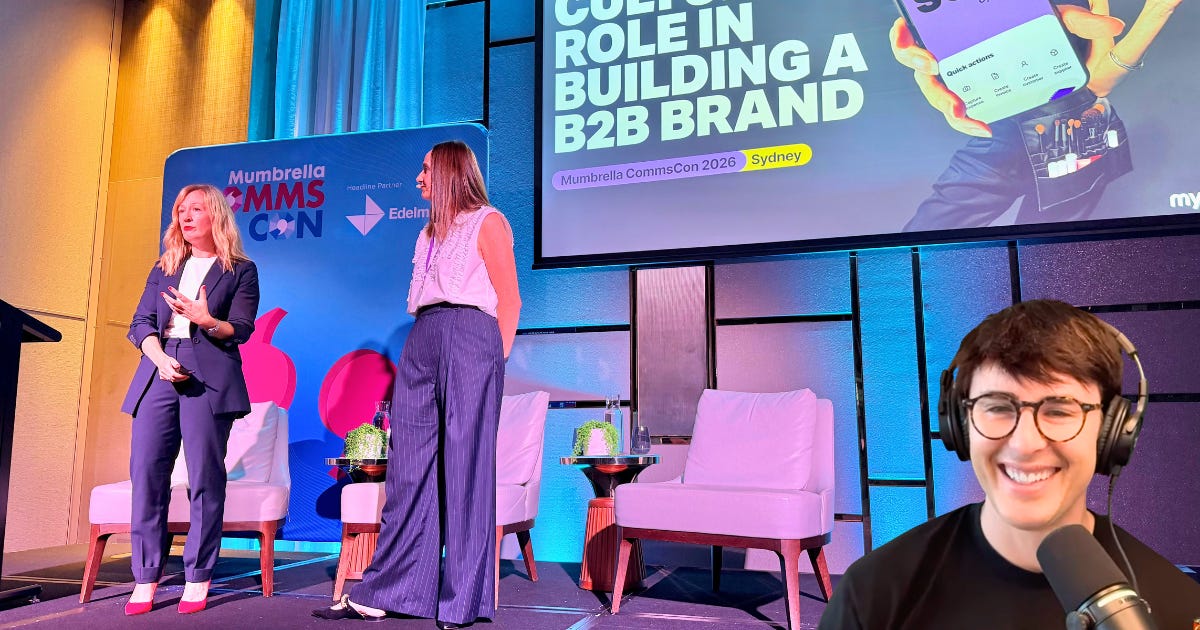
At Mumbrella CommsCon yesterday, MYOB’s Lia Pacquola (GM of Strategic Communications) and Sally Davies (GM of Solo) walked through how they built the product and brand together over two years. What stood out wasn’t the campaign creative or the media results, though both were strong. It was the operating model.
Their comms team wasn’t briefed on the product after it was built. They helped shape it. Product, design, tech, comms, and marketing all ran as one squad from the start, before a line of code was written. Shared objectives. Shared scorecard. One team, not a relay race.
That matters because of what they found when they went deep on their audience. Sole operators are time poor, overwhelmed by admin, and doing their bookkeeping at midnight. But the insight that changed everything wasn’t operational. It was emotional. These people have a confidence gap. They’re turning over hundreds of thousands of dollars a year but telling themselves they’re “just building fences.” They feel like they’re playing business rather than doing business.
Those aren’t feature insights. They’re cultural insights. And they’re far more powerful.
When MYOB anchored in culture rather than category, three things happened. Relevance improved because they were speaking to real tensions, not product specs. The brand moved out of the B2B niche and into mainstream conversations about work, wellbeing, and self-employment. And the product itself got sharper, because starting from cultural tensions forced the team to define the real problem before building the solution.
Bedmin and the one-handed test
One of the strongest moves in the Solo launch was a campaign called “Bedmin.” The insight was simple: sole operators are doing their admin from everywhere. The couch, public transport, between jobs, in bed at 11 pm. They need a product that works one-handed, on a phone, while they’re juggling kids or halfway through another task.
That insight came from the comms team’s cultural research: hours on TikTok and YouTube, watching how sole operators actually live and work. It then shaped concrete product decisions. Mobile-first design. One-handed UX. Admin on autopilot. The campaign and the product were built from the same insight at the same time.
This is where the contrast with the “go broad” approach becomes stark. When you know exactly who you’re building for, every decision gets easier. You don’t need to debate whether to build for mobile or desktop. You don’t need to guess what language will resonate. You’ve spent two years in the world of your user. You know they’re doing invoices with one hand while holding a toddler with the other.
The result was national media coverage, fronted by a real customer (a marriage celebrant already on the platform), not a spokesperson reading talking points. An actual user whose life matched the narrative, because the narrative was built from real life in the first place.
From campaign to platform: imposter syndrome
MYOB didn’t stop at one campaign. The cultural research surfaced another tension: sole operators feeling like impostors in their own businesses. So they built a follow-up campaign around imposter syndrome, directly naming the feeling their customers described.
This is what happens when your comms function isn’t just a distribution channel. When cultural insight feeds continuously into product and positioning, each campaign builds on the last. The brand compounds. You’re not starting from scratch every quarter with a new message about a new feature. You’re deepening a relationship with your audience around something they actually care about.
Compare that to the alternative: a new brand campaign every six months, each one disconnected from the last, each one trying to generate awareness without building anything underneath it. That’s the difference between brand building and brand spending.
Product is the brand. Don’t forget it.
Here’s what the “go broad, spend big” approach misses: in B2B, your product is your most important brand asset. When users interact with your software every day, no amount of marketing can paper over a mediocre experience. If your roadmap is driven by vanity features (things that look good in a press release but don’t solve real problems), your best customers will notice. And eventually, they’ll leave.
This is the risk Xero is running. When you’re the market leader, it’s tempting to believe your brand is the moat. But brand without product innovation is a depreciating asset. The customers who chose you because you were the better product will choose someone else when that stops being true. And they won’t announce it. They’ll just quietly switch.
MYOB understood that the product and the story had to be the same thing. Every feature in Solo exists because the cultural research said it needed to. One-handed use. Mobile-first. 17 hours of admin saved per month. Those aren’t marketing claims bolted on after the fact. They’re design decisions that came from understanding the user deeply enough to build something that genuinely fits their life.
Solo hit 30% above its customer growth targets. It generated over a million dollars in earned media value and 10 million impressions. It won The Australian Financial Review 2025 Most Innovative Company award for financial services.
None of that happened because they outspent the competition. It happened because they out-understood them.
The takeaway
Market leadership is never permanent. Xero proved that when they took it from MYOB. Now, while Xero rests on its brand and relies on marketing to do the work that product should be doing, MYOB is quietly building something that might shift the balance again. Not by outspending them. By out-understanding their users.
If your B2B brand is struggling for cut-through, the problem probably isn’t your product and it probably isn’t your marketing budget. It’s probably that you’re going broad when you should be going deep. Or leading with category language when you should be leading with culture.
Find the specific audience that nobody else is obsessing over. Understand what they actually feel, not just what they need. Build the product and the brand from that insight at the same time. And bring your comms people into the room before the spec is written, not after.
Niche isn’t small. Niche is sharp. And right now, sharp is winning.
Ben van Rooy is CEO and Founder of Human Digital and co-host of Canned the Marketing Podcast. With over 20 years in brand and marketing strategy across New Zealand, Australia, the US, and the UK, he works with businesses that want smarter growth, not just more of it. He holds an MBA from Brown University and the IE Business School.